Underwriting Automation for Lenders: How It Works and Why It Matters
TLDR Underwriting automation replaces slow, inconsistent manual credit decisions with rule-based engines that assess applications in seconds. This article explains how automated underwriting works, what it takes to implement it, and what to look for in a platform.
For most lenders, underwriting is the most important part of the process.
Get it right and you build a healthy, profitable loan book. Get it wrong – through slow decisions, inconsistent criteria, or poor risk assessment – and the consequences compound quickly.
Traditionally, underwriting has been a manual, people-intensive activity. Underwriters review applications, pull credit reports, assess affordability, apply judgment, and make decisions. It works – but it does not scale. As loan volumes grow, the model breaks down: decisions slow, consistency suffers, and operating costs climb.
Underwriting automation addresses this directly. By encoding your risk criteria into a decision engine, lenders can process applications in seconds, maintain consistent standards across every decision, and free their teams to focus on edge cases, strategy, and growth.
What Is Underwriting Automation?
Underwriting automation is the use of software to assess loan applications and make credit decisions based on predefined rules, data inputs, and scoring models – without requiring manual intervention for every case.
Rather than a person reviewing each application, an automated decision engine evaluates the borrower against your lending criteria in real time. Applications that meet your thresholds are approved automatically; those that do not are declined or flagged for manual review.
The engine can draw on a wide range of data inputs:
- Credit bureau data (Experian, Equifax, TransUnion)
- Open banking data – real-time income, expenditure, and account behaviour
- Internal application data (income stated, loan purpose, term requested)
- Proprietary scoring models built on your own portfolio history
- Third-party fraud and identity verification signals
The result is a decision that is faster, more consistent, and fully auditable – delivered at a fraction of the cost of manual review.
Manual vs. Automated Underwriting: A Comparison
| Manual Underwriting | Automated Underwriting | |
|---|---|---|
| Decision speed | Hours to days | Seconds to minutes |
| Consistency | Variable (human judgment) | 100% rule-consistent |
| Scalability | Limited by team size | Scales with volume |
| Cost per decision | High | Low |
| Availability | Business hours | 24/7 |
| Audit trail | Manual, incomplete | Automatic, complete |
| Risk of bias | Possible | Rule-based, transparent |
The case for automation is not simply about speed – it is about building a lending operation that can grow without the constraints of team capacity and human inconsistency.
How Automated Underwriting Works in Practice
Automated underwriting operates as a decision engine – a configurable rules-based system that sits at the heart of your loan management platform. Here is how a typical flow works:
1. Application Data Is Captured
When a borrower submits an application, their data is automatically processed by the system – personal details, income information, loan amount, and requested term.
2. External Data Is Pulled in Real Time
The decision engine calls out to your integrated data providers – credit bureaus, open banking APIs, fraud checks – and pulls back enriched data on the applicant. This happens in seconds and requires no manual input from your team.
3. Scoring and Rules Are Applied
The engine evaluates the applicant against your configured risk model. This might include a minimum credit score threshold, a maximum debt-to-income ratio, an affordability calculation, a fraud risk score, and any additional criteria specific to your product.
4. A Decision Is Rendered
Based on the scoring output, the application is automatically approved, declined, or referred for manual review. The decision is logged with a full audit trail – including which rules were applied and what data was used.
5. The Borrower Is Notified
An automated communication is triggered immediately, sending the decision to the borrower via email or SMS. If approved, the loan offer follows automatically. The entire flow, from submission to offer, can happen without a single manual touch.
The Business Case for Underwriting Automation
Speed as a Competitive Advantage
In consumer lending, decision speed is a direct driver of conversion. Borrowers who receive an instant or same-day decision are significantly more likely to proceed than those left waiting for a callback or manual review. For lenders competing in a crowded market, this is a core competitive differentiator.
Our own research found that nearly 70% of borrowers expect same-day loan decisions.
Consistency and Compliance
Manual underwriting introduces variability. Different underwriters apply criteria differently; fatigue, workload, and subjectivity all play a role. An automated engine applies your rules identically every time – which is more efficient and easier to defend to regulators. Every decision is logged, traceable, and explainable.
Scalability Without Proportional Headcount Growth
Your decision engine can process 100 applications or 10,000 applications with the same infrastructure. You scale loan volume without needing to hire an underwriter for every increment of growth. LendFusion customers like Planet42 grew from a zero portfolio to 100 million euros without rebuilding their operations – automation was central to that.

Better Risk Management
Automated systems do not just speed up decisions – they improve them. By incorporating richer data sources and applying consistent scoring logic, lenders can make more accurate risk assessments than a busy human reviewer working from a printed credit report. Arrears and default rates typically improve after automation is implemented.
What to Look for When Implementing Automated Underwriting
Not all decision engines are created equal.
When evaluating platforms, growing lenders should look for:
- No-code configuration – the ability to set and adjust your own rules, thresholds, and scoring models without developer involvement. Your risk appetite will evolve; your platform should let you change it quickly.
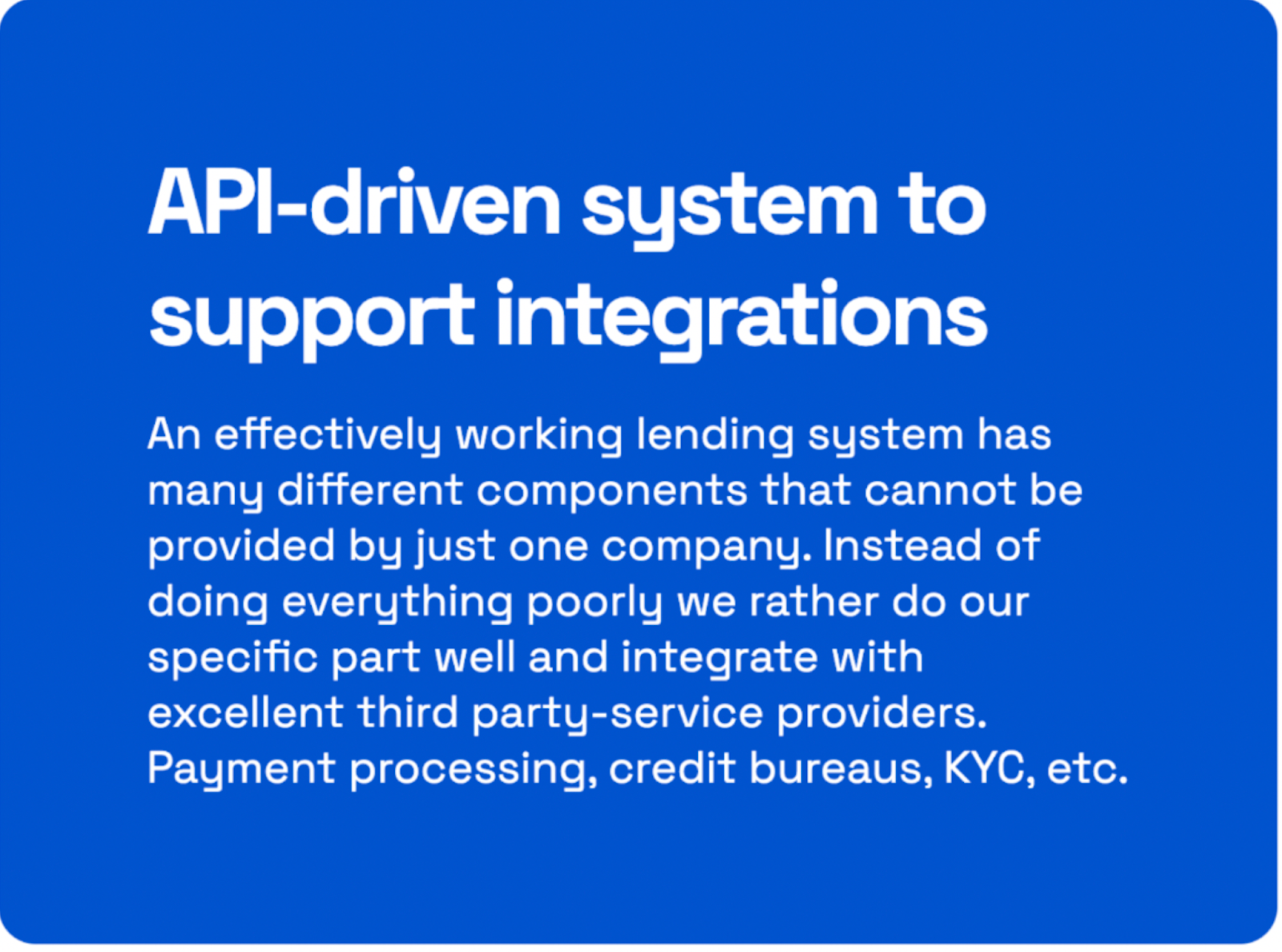
- Native integrations with credit bureaus and open banking providers – so data flows into the engine automatically rather than requiring manual lookups.
- Referral workflows – a sophisticated engine does not just approve or decline. It identifies edge cases worth a human look and routes them to the right reviewer.
- Full audit trail – every decision, every data input, every rule applied must be logged for compliance and portfolio analysis.
- Flexible product support – your decision logic for a 12-month personal loan will differ from a bridge loan or BNPL product. Your engine should support multiple products with distinct rule sets.
LendFusion’s built-in decision engine covers all of these – and because it sits within a full loan management platform, decisions flow directly into the origination workflow, contract generation, and disbursement without manual handoffs.
Automation Is the Foundation of a Scalable Lending Business
Underwriting automation is the operational foundation that makes scale possible.
It removes the bottleneck of manual review, brings consistency and rigour to every credit decision, and gives your team back the time to focus on what drives growth.
The best implementations give lenders full control over their risk criteria, full visibility over every decision, and full flexibility to adapt as their business evolves.
If you are still relying on manual underwriting – or a disconnected decisioning tool – it is worth asking: what is it costing you in slow decisions, inconsistent approvals, and missed growth?
See Automated Underwriting in Action
LendFusion’s built-in decision engine lets you configure your own rules, connect to leading credit bureaus and open banking providers, and automate your entire lending workflow – no developers required. Go live in weeks, not months.
Book a personalized demo today.

Andres Valdmann, CEO
Andres is the Chief Executive Officer at LendFusion. Andres has 15 years of experience in fintech and loan management software and has a proven track record in helping companies hit their growth goals.
Connect with Andres on LinkedIn.