10 Types of Loan Management Software (and Which One You Actually Need)
Quick Summary
There is no universal loan management system — each lending model has different operational requirements. Here is a map of the 10 types and who each is built for:
| LMS Type | Best For | LendFusion Fit |
|---|---|---|
| Loan Origination Software | Digital-first lenders & high application volumes | ✓ Full origination suite built-in |
| Loan Servicing Software | Teams managing active loans, repayments & collections | ✓ End-to-end servicing included |
| Auto Loan Management | Vehicle finance lenders with collateral complexity | ✓ Auto-specific workflows |
| Consumer Lending Software | Personal loan, BNPL & credit union lenders | ✓ Core consumer lending platform |
| Commercial Lending Software | Business lenders & commercial portfolio managers | ✓ Configurable for commercial use |
| Microfinance Software | High-volume, small-ticket lenders & impact finance | ✓ Scales to high loan volumes |
| Bridge Loan Software | Short-term property & bridging finance lenders | ✓ Retained interest & LTV support |
| Mortgage Loan Software | Residential & property lenders with long loan terms | ✓ Schedule & compliance tooling |
| P2P Lending Software | Platforms connecting individual investors to borrowers | ✓ Investor portal & multi-investor |
| International Loan Software | Cross-border lenders with multi-currency portfolios | ✓ Multi-market deployments |
Running a lending business today is not about finding borrowers — it is about managing complexity. Spreadsheets, legacy CRMs, and one-off tools can get you started, but they do not scale. At some point, the cracks appear: payments delayed, compliance reports missed, borrowers frustrated, and teams working overtime just to keep the book balanced.
That is when most lending CEOs realise they do not just need a system — they need the right one.
The challenge? Loan management software is not one-size-fits-all. Auto finance is not the same as bridge lending. Consumer loans look very different from commercial portfolios.
In our latest survey of 300 lending CEOs, more than 40% said short-term lending was their primary product — followed closely by personal loans and business finance. That mix of needs is exactly why there is no single winner.
This guide breaks down the 10 major types of LMS — what they do, who they are built for, the honest trade-offs, and how to know which fits your lending model. We have built LendFusion to serve lenders across most of these categories, which means we have spent years understanding where each type excels and where it falls short.
Why Trust This Guide?
At LendFusion, we have spent a decade building loan management infrastructure for specialist lenders across Europe and beyond. Our customers range from consumer lenders processing thousands of applications per month to bridge lenders managing a handful of high-value, complex deals. We have seen what breaks at scale, what works in practice, and where most lenders waste time evaluating the wrong type of system entirely.
This guide reflects that hands-on experience — not a feature list from a vendor brochure. Where we think a different type of platform is a better fit than LendFusion, we will say so.
When to Move Beyond Spreadsheets
Every lender starts with Excel. It is fast, familiar, and free. But our survey found that one in three lending CEOs still manages their portfolio in spreadsheets — and most admit it is their biggest operational bottleneck.
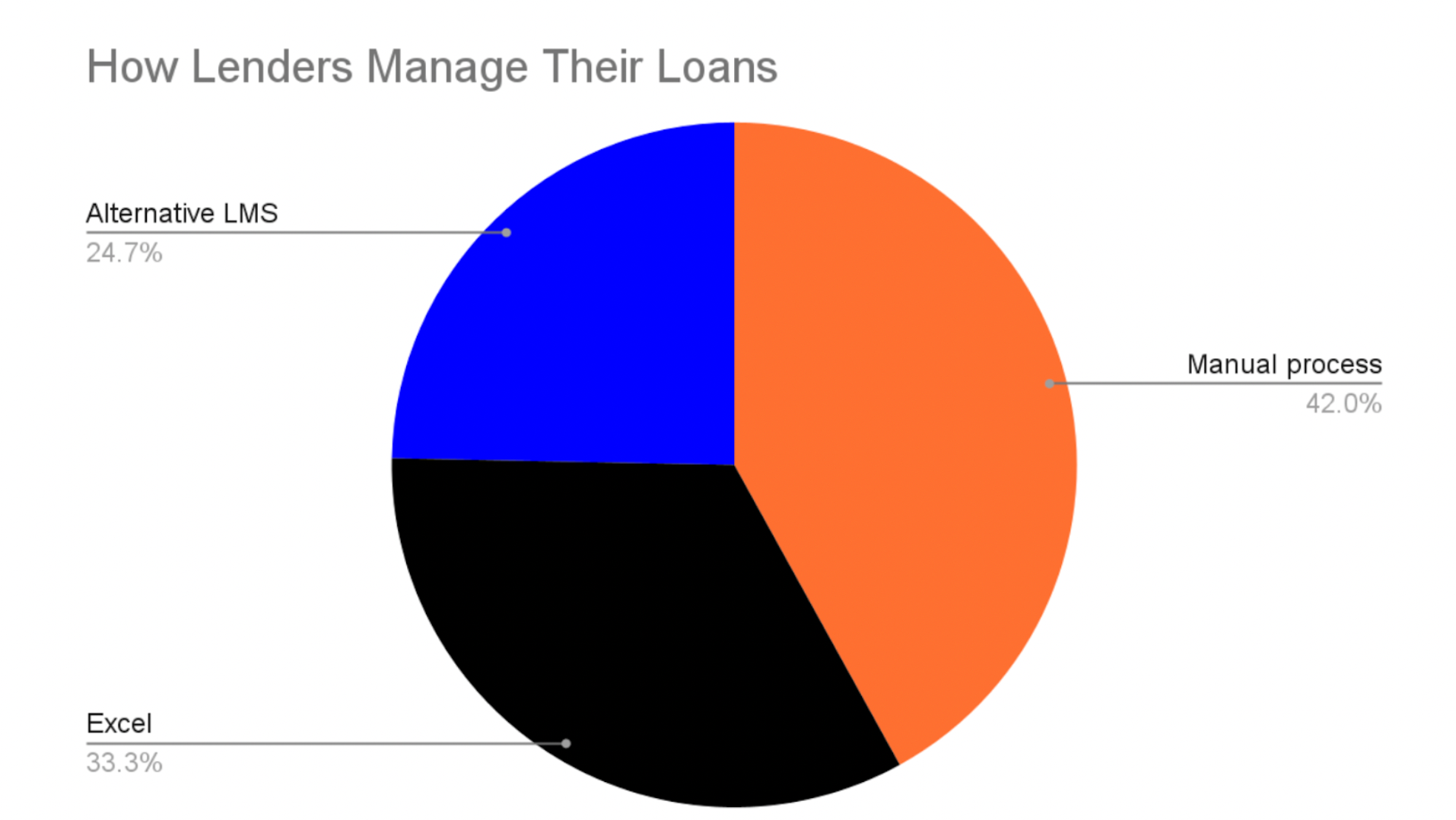
The case for moving from Excel to a loan management system comes down to four risks that compound as volume grows:
- Errors multiply — one wrong formula can ripple across repayments and investor reporting
- No audit trail — regulators demand transparency; spreadsheets cannot provide it
- Manual drag — updating balances, chasing payments, and reconciling reports consumes hours every week
- Security exposure — sensitive borrower data in unsecured files is a compliance liability
The good news: platforms like Lendfusion handle all of this automatically — origination decisions run on consistent rules, servicing tasks happen without manual triggers, and compliance reports generate in real time. Teams reclaim time, borrowers get smoother experiences, and lenders can scale without hiring armies of ops staff.
The 10 Types of Loan Management Software
1. Loan Origination Software (LOS)
Built for the front end — turning applications into approved loans, fast.
Loan origination software automates and streamlines the application and approval process. It is the system lenders use to take a borrower from ‘I want a loan’ to ‘here are your terms’ — handling data collection, document verification, credit decisioning, and compliance checks along the way.
The distinction between origination and servicing software is one of the most common sources of confusion when evaluating platforms. LOS is focused on the front end — getting loans approved. What happens after disbursement is a different question.
Key Features
- Automated application intake and document verification
- Rules-based credit decisioning without manual underwriter involvement
- Integration with credit bureaus and open banking for real-time data
- Compliance tracking and audit trails from day one
- Configurable approval workflows for different loan products
Best For
Digital-first lenders and any business processing high application volumes who need fast, consistent credit decisions without growing their underwriting team.
Pros & Cons
| Pros | Watch Out For |
|---|---|
| Slashes time-to-decision significantly | Standalone LOS platforms require a separate servicing system |
| Removes human inconsistency from credit decisions | Over-engineered for lenders with very low volume or simple products |
| Scales to high application volumes without adding headcount | Watch out for platforms that lock scoring rules — you need to own your criteria |
LendFusion on this: LendFusion includes a full origination suite — configurable decision engine, bureau integrations, document workflows — within the same platform that handles servicing and collections. No need to stitch two systems together.
2. Loan Servicing Software (LSS)
The engine room — managing everything that happens after a loan is issued.
Loan servicing software manages the lifecycle of active loans: payment collection, account updates, repayment reminders, delinquency management, and portfolio reporting. If origination is about acquiring a loan, servicing is about running it profitably until it is repaid.
For many growing lenders, this is where the operational bottleneck sits. Manual repayment tracking, chasing missed payments, and producing portfolio reports consume enormous amounts of team time. Loan automation in servicing is where the ROI tends to be fastest and most measurable.
Key Features
- Automated payment collection via direct debit, card, or bank transfer
- Pre-payment reminders and escalation workflows for arrears
- Real-time loan performance tracking and portfolio dashboards
- Self-service borrower portal to reduce inbound support
- Compliance tools and automated audit trails
Best For
Any lender with an active loan book — but especially those where manual servicing tasks are consuming significant team time or where arrears management is reactive rather than proactive.
Pros & Cons
| Pros | Watch Out For |
|---|---|
| Directly reduces cost-to-serve per loan | Standalone servicing tools require integration with origination systems |
| Proactive arrears management improves portfolio quality | Repayment automation is only as good as the payment provider integrations |
| Borrower self-service significantly reduces support queries | Some platforms lack flexibility for non-standard repayment structures |
LendFusion on this: Servicing is at the core of what LendFusion was built to do — automated collections, self-service borrower portal, real-time reporting, and repayment flexibility are all included out of the box.
3. Auto Loan Management Software
Specialised for vehicle finance — where collateral, compliance, and payment tracking intersect.
Auto loan software is a specialised variant of loan management software tailored to the specific needs of vehicle finance lenders. The key differentiator is collateral management: auto loans are secured against a physical asset whose value depreciates, meaning lenders need tools that track LTV ratios, monitor asset condition, and manage the full collateral lifecycle alongside the financial one.

Key Features
- Collateral tracking and LTV ratio monitoring
- Automated payment processing and delinquency management
- Compliance workflows for vehicle finance regulation
- Loan origination with credit bureau integration
- Performance analytics for auto loan portfolios
Best For
Vehicle finance lenders — dealer finance, independent auto lenders, and fleet finance providers — where collateral management is a core operational requirement.
Pros & Cons
| Pros | Watch Out For |
|---|---|
| Collateral workflows designed for vehicle-specific complexity | Overly specialised for lenders running mixed loan books |
| LTV monitoring reduces exposure on depreciating assets | Some platforms are dealer-first and not well-suited for direct lenders |
| Regulatory compliance tools built for auto finance context | Data integrations for vehicle databases vary significantly in quality |
LendFusion on this: LendFusion handles auto loan portfolios with configurable collateral tracking, automated payment processing, and portfolio reporting — within the same platform used for other loan products.
4. Consumer Lending Software
High volumes, fast decisions, borrower-first experience — the consumer lending engine.
Consumer lending software manages individual borrowing: personal loans, BNPL, credit lines, and other retail credit products. The defining characteristics of consumer lending — high volume, fast decisions, regulatory scrutiny, and borrower expectations shaped by fintechs — demand a platform built specifically for this context.
For a detailed breakdown of how the consumer lending lifecycle works from application to repayment, see our guide on the consumer lending process.
Key Features
- Automated loan origination and underwriting
- Self-service borrower channels (portal, SMS, email)
- Credit bureau and open banking integrations for real-time decisioning
- Flexible repayment structures including BNPL
- Fair lending and consumer protection compliance tooling
Best For
Personal loan providers, credit unions, BNPL platforms, and any lender whose primary customer is an individual borrower rather than a business.
Pros & Cons
| Pros | Watch Out For |
|---|---|
| Purpose-built for the speed and volume demands of consumer lending | Consumer-specific platforms may lack flexibility for commercial products |
| Self-service features meaningfully reduce operational costs | Borrower self-service quality varies significantly between vendors |
| Compliance tooling designed for consumer protection regulations | Watch for platforms that charge per-borrower rather than per-loan-book size |
LendFusion on this: Consumer lending is one of LendFusion’s core use cases — with origination, servicing, collections, and a full borrower portal in one platform designed for scale.
5. Commercial Lending Software
Built for complexity — business loans, credit lines, and large portfolio management.
Commercial lending software is designed for lenders extending credit to businesses rather than individuals. Commercial loans are typically larger, longer, and more complex than consumer loans — involving detailed financial analysis, complex risk assessment, covenant tracking, and relationships that span years rather than months.

Key Features
- Comprehensive risk assessment and credit analysis workflows
- Credit line management with draw-down and repayment flexibility
- Covenant and condition monitoring
- Portfolio management with advanced reporting
- Integration with accounting and ERP systems
Best For
Business lenders, invoice finance providers, SME lenders, and commercial property finance teams managing large-ticket, relationship-driven portfolios.
Pros & Cons
| Pros | Watch Out For |
|---|---|
| Handles the complexity of commercial credit structures | Often over-engineered for simple term loan portfolios |
| Portfolio-level visibility across large and varied loan books | Implementation timelines can be long for enterprise-grade commercial platforms |
| Covenant and condition tracking reduces exposure on complex deals | Integration complexity with borrower accounting systems can be significant |
LendFusion on this: LendFusion supports commercial lending use cases with configurable loan structures, complex repayment schedules, and portfolio reporting — without the implementation overhead of enterprise systems
6. Microfinance Software
Designed for high-volume, small-ticket lending — where operational efficiency is everything.
Microfinance software is purpose-built for institutions extending small loans — often to underserved borrowers or in emerging markets — where the volume of transactions is high and the margin per loan is thin. Efficiency is everything: a platform that requires manual intervention for each loan simply does not work at microfinance scale.
Key Features
- AI-accelerated credit scoring for high-volume, fast decisioning
- Group lending and solidarity group management
- Mobile-first borrower interfaces for low-connectivity environments
- Impact measurement and portfolio reporting
- Field officer tools and offline data collection
Best For
Microfinance institutions, community development finance institutions (CDFIs), and any lender extending small-ticket loans at high volume — particularly in emerging or underserved markets.
Pros & Cons
| Pros | Watch Out For |
|---|---|
| Operational efficiency at high volume that generalist platforms cannot match | Specialist platforms may lack flexibility for products beyond core microloans |
| Impact measurement built into the reporting layer | Some platforms are region-specific and not suitable for international operations |
| Mobile-first design suited for field-based lending | Integration with mainstream payment rails can be limited in some markets |
LendFusion on this: LendFusion scales to high loan volumes with automated decisioning and servicing — suitable for lenders processing thousands of loans without proportionally growing headcount.
7. Bridge Loan Software
Short timelines, high complexity, collateral-heavy — bridging finance needs its own tools.
Bridge loan software is designed for lenders extending short-term, high-value loans — typically secured against property — to borrowers who need quick access to capital while longer-term financing is arranged. The complexity of bridging finance sits in the collateral, the speed of execution, and the variety of interest and repayment structures (rolled-up, retained, serviced).
Key Features
- LTV calculation and collateral management
- Retained, rolled-up, and serviced interest schedule support
- Digital signature and fast document management
- Origination workflows built for speed
- Activity tracking and borrower communication tools
Best For
Property bridging lenders, development finance providers, and any short-term lender where collateral management and speed of execution are the defining operational requirements.
Pros & Cons
| Pros | Watch Out For |
|---|---|
| Collateral and LTV tools designed for property-secured lending | Highly specialised platforms may not support expansion into other products |
| Interest structure flexibility for bridging-specific products | Some bridging software is built for brokers rather than lenders — check the focus |
| Fast origination workflows match the speed expectations of bridging borrowers | Collateral valuation integration quality varies significantly |
LendFusion on this: LendFusion supports bridge loan operations with retained and rolled-up interest schedules, LTV tracking, and fast origination workflows — used by specialist bridging lenders across the UK and Europe.
8. Mortgage Loan Management Software
Long loan terms, regulatory complexity, and high borrower expectations — mortgage needs specialist tooling.
Mortgage loan management software handles the full lifecycle of residential and commercial mortgage products — from origination and underwriting through to long-term servicing, escrow management, and eventual payoff. Mortgages are among the most regulated and complex loan products, with documentation requirements, compliance frameworks, and amortisation structures that generalist platforms often handle poorly.
Key Features
- Automated underwriting and credit evaluation workflows
- Escrow, payment, and amortisation schedule management
- Compliance management for residential mortgage regulation
- Document storage and management for high-volume paperwork
- Customer account management over long loan terms
Best For
Residential mortgage lenders, housing finance institutions, and commercial property lenders with long-duration loan portfolios requiring strong compliance and document management.
Pros & Cons
| Pros | Watch Out For |
|---|---|
| Compliance tools designed for the regulatory complexity of mortgage products | Mortgage-specific platforms often overkill for bridging or short-term lenders |
| Document management scaled to the volume mortgage lending requires | Implementation can be lengthy given the compliance configuration required |
| Amortisation and escrow handling that generalist platforms often lack | Pricing reflects the complexity — often higher than generalist alternatives |
LendFusion on this: LendFusion handles mortgage-style loan structures with flexible amortisation schedules, compliance tooling, and long-term servicing — suitable for lenders who do not need a dedicated mortgage-only platform.
9. Peer-to-Peer (P2P) Lending Software
Matching investors to borrowers — the infrastructure behind marketplace lending.
P2P lending software powers platforms that connect individual or institutional investors directly to borrowers — managing the matching, compliance, payment distribution, and risk monitoring that marketplace lending requires. The defining complexity of P2P software is the investor layer: loans must be split, distributed, and tracked across multiple investors simultaneously, with transparent reporting to all parties.
Key Features
- Borrower-investor matching based on risk profiles and product criteria
- Automated credit scoring and risk assessment
- Multi-investor disbursement and payment distribution
- Investor portal with real-time portfolio reporting
- Compliance monitoring for P2P-specific regulatory requirements
Best For
P2P lending platforms, marketplace lenders, and any fintech building an infrastructure that connects capital providers directly to borrowers — rather than deploying proprietary capital.
Pros & Cons
| Pros | Watch Out For |
|---|---|
| Multi-investor architecture purpose-built for marketplace lending | Highly specialised — limited value for balance-sheet lenders |
| Investor portal reduces manual reporting overhead | Some P2P platforms are underinvested in the borrower experience |
| Compliance tools designed for the dual regulatory obligations of P2P platforms | Regulatory complexity of P2P means compliance tooling must be kept current |
LendFusion on this: LendFusion supports multi-investor loan structures and investor reporting — making it suitable for lenders with an investor funding model who need transparency and control on both sides of the transaction.
10. International Loan Management Software
Cross-border lending — multi-currency, multi-jurisdiction, and locally compliant.
International loan management software is built for lenders operating across multiple markets — managing the currency conversion, regulatory compliance, localisation, and payment infrastructure that cross-border lending requires. As lenders like Gaia have demonstrated, scaling across markets without the right infrastructure is one of the fastest routes to operational chaos.

Key Features
- Multi-currency loan origination and repayment processing
- Localisation for language, date formats, and regional compliance
- Secure cross-border payment processing
- Compliance tooling for multiple regulatory jurisdictions
- Centralised portfolio view across all markets and currencies
Best For
Lenders operating in or expanding into multiple markets — particularly where regulatory requirements, currencies, or borrower expectations differ significantly between geographies.
Pros & Cons
| Pros | Watch Out For |
|---|---|
| Multi-jurisdiction compliance without a separate platform per market | International platforms can add complexity for lenders operating in a single market |
| Centralised reporting across currencies simplifies investor and management reporting | Currency risk management sits outside most LMS platforms — requires separate tooling |
| Localisation reduces friction in new markets | Regulatory updates across multiple jurisdictions require active vendor maintenance |
LendFusion on this: LendFusion has been deployed across multiple markets by lenders like Gaia — with multi-currency support, local compliance configuration, and the scalability to add markets without rebuilding operations.
All 10 Types at a Glance
| LMS Type | Description | Best For | Key Feature | Suggested Platforms |
|---|---|---|---|---|
| Loan Origination | Automates application intake, credit checks & approval | Digital lenders, banks, credit unions | Rules-based decision engine | LendFusion, Finastra, HES FinTech |
| Loan Servicing | Manages payments, collections & loan tracking | Servicing teams & ops-heavy portfolios | Automated repayment & arrears | LendFusion, LoanPro, TurnKey Lender |
| Auto Loan | Tailored for vehicles: collateral, payment tracking | Auto finance providers | Collateral & LTV tracking | LendFusion, Appello, HES FinTech |
| Consumer Lending | Handles personal loans: credit, docs, self-service | Credit unions, personal loan lenders | Self-service borrower portal | LendFusion, BrightOffice, Finastra |
| Commercial | Business loans: credit lines, portfolio & risk tracking | Commercial lenders & B2B finance | Complex risk assessment | LendFusion, LoanPro, Finastra |
| Microfinance | High-volume, small loans with impact measurement | Microfinance institutions | AI credit scoring at scale | LendFusion, Mifos, Musoni |
| Bridge Loan | Short-term, high-interest with collateral management | Property & bridging lenders | LTV calc & retained interest | LendFusion, The Mortgage Office |
| Mortgage | Long-term home loans: underwriting, escrow, compliance | Mortgage lenders, housing banks | Amortisation & escrow tracking | LendFusion, Finastra, Mortgage Automator |
| P2P Lending | Connects borrowers & investors with compliance tooling | P2P platforms, fintech startups | Multi-investor disbursement | LendFusion, Crowdsoft, Madiston |
| International | Cross-border: multi-currency, localisation, global rules | Global lenders & multi-market operations | Multi-currency & multi-jurisdiction | LendFusion, Mambu, Finastra |
What Type of LMS Is LendFusion?
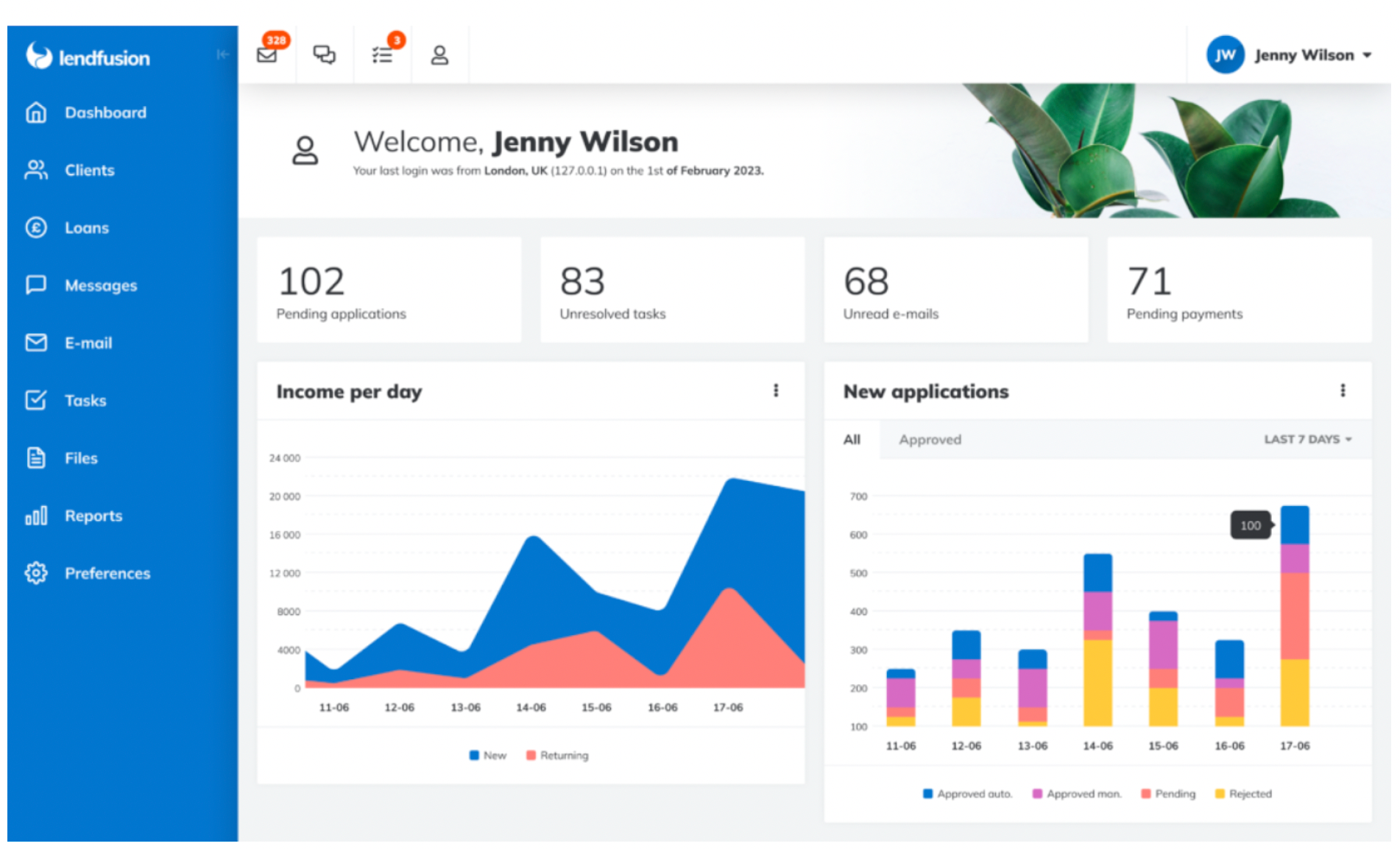
LendFusion is a comprehensive loan management platform that spans multiple categories — origination, servicing, consumer, commercial, bridge, auto, BNPL, and international lending.
Rather than being a point solution for one type of lending, it is designed to be the operating system for a growing lender’s full lifecycle: from the first application to final repayment.
This versatility is deliberate. Growing lenders rarely stay in one category — they expand product ranges, enter new markets, and evolve their operational model. A platform that handles only one type of lending becomes a constraint. LendFusion is built to scale with you, not against you.
For a full picture of what that looks like in practice, see how LendFusion works.
Key capabilities across all lending types include:
- Configurable decision engine — no-code rules, bureau integrations, automated approvals
- End-to-end loan lifecycle management — origination through collections in one platform
- Automated workflows — reduce manual admin across every stage
- Real-time portfolio reporting — full visibility across your loan book
- Compliance and audit trail — built-in, not bolted on
- Dedicated onboarding and support — live in weeks, not months
How to Choose the Right Type of LMS for Your Business
Not every lender needs the most feature-rich platform on the market. The right question is: which type of LMS fits your current lending model and your growth trajectory? Here is a simple framework:
Step 1: Define your primary loan product
Start with what you actually lend. A bridge lender and a consumer lender have fundamentally different operational requirements. Picking the wrong category — however good the platform — means fighting your own system. Our guide on types of loan management software and their fit goes deeper on matching product to platform.
Step 2: Identify your biggest operational bottleneck
Is the problem at origination (slow approvals, manual underwriting)? Or servicing (chasing repayments, poor reporting)? Or both? The answer shapes whether you need a dedicated LOS, a servicing-focused platform, or an end-to-end system. Our piece on reducing loan decision times is useful if origination speed is the core issue.
Step 3: Think about where you will be in three years
A platform that fits your current operation perfectly but cannot support a new product line or a new market is a short-term solution to a long-term problem. The best loan management software for growing lenders is one that scales with your ambitions, not just your current state.
Step 4: Evaluate integration depth, not just feature lists
The value of a loan management platform is often in what it connects to: payment providers, credit bureaus, open banking APIs, accounting systems. A rich lending operations stack requires a platform that integrates well, not just one that lists integrations in a brochure. Ask to see them working in a demo.
Not sure which type of LMS is right for you?
Book a 30-minute call with a LendFusion specialist. We will walk through your lending model, identify the right platform type, and show you exactly how LendFusion handles your specific use case — no generic demos, no sales pressure.
Book your free demo at lendfusion.com/demo
Lenders Also Ask
How do the specific features of microfinance software contribute to its effectiveness in managing microloans?
The effectiveness of microfinance software comes from features like AI-accelerated credit scoring, real-time loan portfolio performance insights, and streamlined analysis of loan performance data. These tools enable efficient loan origination and portfolio management at high volume — catering to the unique operational needs of microfinance institutions where margin per loan is thin and scale is everything.
In what ways does bridge loan software streamline the management of short-term loans compared to traditional methods?
Bridge loan software streamlines short-term loan management through digital signature capabilities, API integration, and efficient loan origination processes designed for speed. It also includes collateral tracking, LTV calculation, and activity alerting — replacing the manual document-chasing and spreadsheet reconciliation that slows down traditional bridging operations. The result is faster deal execution and better visibility over collateral exposure.
Can commercial lending software integrate with other business systems to provide a comprehensive view of a borrower’s profile?
Yes — commercial lending platforms typically offer API-based integration with accounting systems, CRMs, ERP tools, and credit bureau providers. This allows lenders to consolidate financial data, communication history, and risk assessment inputs in one place — giving underwriters a fuller picture of a borrower’s profile and enabling more informed credit decisions without manual data aggregation.
What is the difference between loan origination software and loan servicing software?
Loan origination software handles the front end of the lending lifecycle — application intake, credit decisioning, document management, and approval. Loan servicing software takes over after disbursement, managing repayments, arrears, communications, and portfolio reporting. Many lenders start with one and later need the other; the most efficient operations use a platform that handles both. For a full breakdown, see our guide on loan origination software vs. loan servicing software.
How do I know when my lending business has outgrown spreadsheets?
The clearest signals are: repayment errors appearing in your book, compliance reports taking more than a day to produce, team members spending more than a quarter of their time on manual admin, or borrower complaints about communication delays. Our guide to moving from Excel to a loan management system covers the warning signs in detail — and what to look for in a replacement platform.

Andres Valdmann, CEO
Andres is the Chief Executive Officer at LendFusion. Andres has 15 years of experience in fintech and loan management software and has a proven track record in helping companies hit their growth goals.
Connect with Andres on LinkedIn.