Credit Decision Engine Software: What It Is, How It Works, and What to Look For
TLDR A credit decision engine is the software that automates how lenders approve, decline, or refer loan applications — replacing manual underwriting with consistent, rules-based decisions delivered in seconds. This article explains how decision engines work, what separates good ones from bad ones, and why it matters whether yours is built into your loan management platform or bolted on from outside.
Every time a lender approves or declines a loan application, a decision is being made. The question is: how is that decision being made — and how consistently?
For lenders operating at low volume, a manual review process can work. An underwriter looks at the application, pulls a credit report, checks affordability, applies their judgment, and makes a call. It is slow and it varies person to person, but it functions.
The moment volume grows — or the moment that lender wants to grow volume — the model breaks. Manual underwriting does not scale. And inconsistent decisions create two problems simultaneously: operational bottlenecks that slow down approvals, and credit risk that varies depending on who reviewed the file.
A credit decision engine solves both. It encodes your lending criteria into software, applies them consistently to every application, and returns a decision in seconds rather than hours. It is the engine behind underwriting automation — and for any lender who wants to grow without proportionally growing their underwriting team, it is not optional.

What Is a Credit Decision Engine?
A credit decision engine is software that evaluates loan applications against a set of predefined rules and data inputs, and returns an automated outcome — approved, declined, or referred for manual review.
At its core, it is a rules engine: a system that takes inputs (applicant data, credit bureau scores, income information, fraud signals) and runs them through your criteria to produce a consistent output. But modern decision engines go further than simple rule-matching. They can:
- Pull data from multiple sources simultaneously — credit bureaus, open banking, internal systems — and combine them into a single decision
- Apply weighted scoring models that go beyond binary pass/fail rules
- Handle complex conditional logic — for example, applying different criteria to borrowers above or below a certain income threshold
- Route edge cases to a human underwriter with the right context pre-populated
- Log every decision with a full audit trail for compliance and review
The result is a credit decisioning process that is faster, more consistent, and fully traceable — without requiring a person to touch every application.
How a Credit Decision Engine Works in Practice
The flow of a typical automated credit decision looks like this:
Step 1: Application data is received
The borrower submits an application — through a web form, a mobile app, or a broker portal. The data flows directly into the decision engine: personal details, employment status, income, loan amount requested, and purpose.
Step 2: External data is enriched in real time
The engine calls out to integrated data providers simultaneously: a credit bureau for a credit report and score, an open banking API for real-time income and expenditure data, and a fraud and identity verification provider. This enrichment happens in seconds and does not require any manual data pulling.
Step 3: Your rules are applied
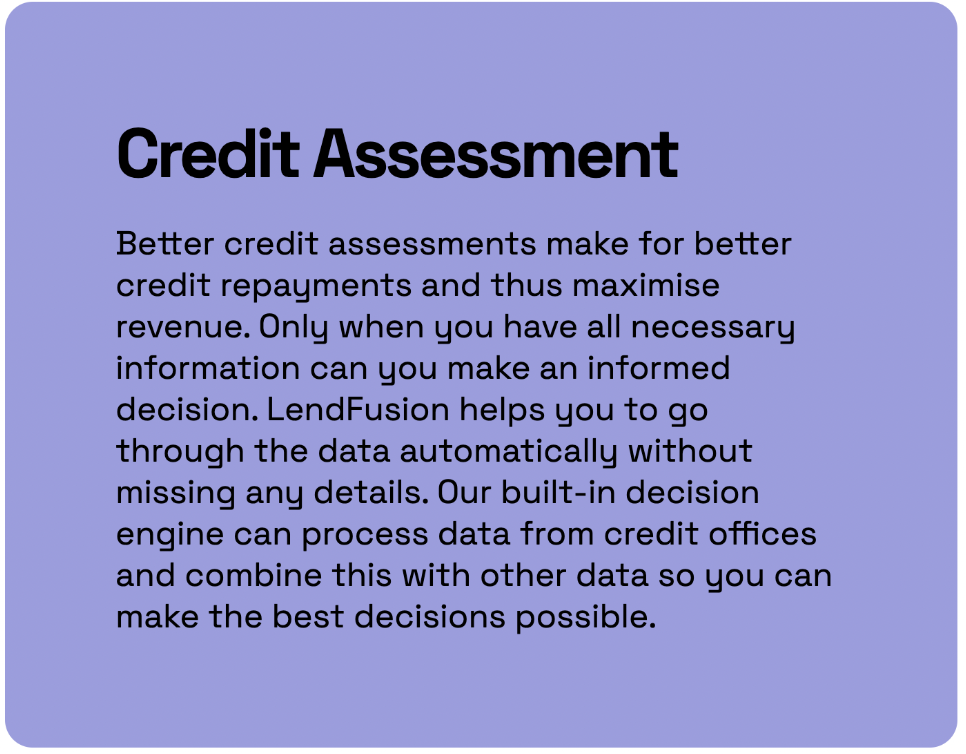
The engine evaluates the enriched application against your configured criteria. This might include a minimum credit score, a maximum debt-to-income ratio, an affordability calculation, an income verification threshold, and a fraud risk score ceiling.
Rules can be applied sequentially (waterfall logic) or simultaneously — the configuration depends on your product and risk model.
Step 4: A decision is returned
Based on the rules output, the application is automatically approved, declined, or referred. The decision is instantaneous from the borrower’s perspective.
The engine logs the outcome along with every rule that was evaluated, every data point that was used, and the score or threshold at which the decision was made — creating a complete audit trail without any additional work.
Step 5: The workflow continues automatically
If approved, the loan offer is generated and sent to the borrower — automatically. The decision engine hands off to the rest of the loan management workflow: contract generation, e-signature, disbursement. The entire journey from application to funded loan can happen without a single manual step for clean cases.
Rules-Based vs. Model-Based Decisioning
Decision engines typically operate in one of two modes — or a combination of both.
Rules-based decisioning
Your criteria are configured as explicit rules: if credit score is above X and debt-to-income ratio is below Y and fraud score is below Z, approve.
Rules-based engines are transparent, easy to audit, and straightforward to update when your risk appetite changes. They are the right starting point for most growing lenders — and the foundation of good underwriting automation.
Model-based decisioning
A statistical or machine learning model is trained on historical loan performance data and generates a probability-of-default score for each applicant. That score feeds into the decision — either as the sole input or alongside rules.
Model-based decisioning can be more accurate than pure rules, particularly for borrowers in the middle of your credit distribution, but it requires sufficient historical data to train reliably and introduces explainability challenges. Predictive analytics in lending covers how lenders build and deploy these models in more detail.
The practical starting point
For most growing lenders, a rules-based engine with bureau and open banking integration is the right starting configuration. It is transparent, immediately deployable, and gives you consistent decisions from day one — without needing a portfolio of historical data to train a model. As your book grows and you accumulate performance data, model-based scoring can be layered in on top.
Build vs. Buy: The Decision Every Lender Faces
Some lenders — particularly those with technical co-founders or engineering teams — consider building their own decision engine. It is worth understanding what that actually involves before making the call.
| Build In-House | Decision Engine Platform | |
|---|---|---|
| Time to deploy | 6–18 months | Weeks |
| Upfront cost | Very high | Low–medium |
| Ongoing maintenance | Your team | Vendor |
| Rule changes | Developer required | No-code, self-serve |
| Integration support | You build it | Pre-built connectors |
| Scales with volume | Requires re-investment | Included |
| Regulatory updates | Your responsibility | Vendor-managed |
The build option looks appealing because it promises total control.
In practice, it means diverting significant engineering resources away from your core product, taking on ongoing maintenance and regulatory compliance obligations, and accepting a 6–18 month timeline before the engine is production-ready. Most lenders who have been through it conclude it was not the right use of their team’s time.
The best loan origination software platforms include a decision engine as a native capability — not a separate integration. That distinction matters more than it might seem.
Standalone Engine vs. Integrated Platform: Why It Matters
One of the most important architectural decisions when choosing a credit decision engine is whether it sits inside your loan management platform or connects to it from outside.
A standalone decision engine — one that operates separately and passes decisions back to your LMS via API — introduces friction at the exact point where speed matters most. Every integration is a potential failure point. Data passed between systems can go out of sync. A decision made in one system needs to be acted on in another. Your team ends up managing two platforms instead of one.
An integrated decision engine — one that is native to your loan management platform — eliminates all of that. The decision is made inside the same system that generates the offer, manages the contract, and initiates disbursement. There are no handoffs, no sync issues, and no latency between the decision and the next step in the origination workflow.
What to Look for in a Credit Decision Engine
Not all decision engines are equal. Here is what separates platforms that genuinely improve lending operations from those that just add a layer of complexity:
| Feature | Why It Matters |
|---|---|
| No-code rule configuration | Can your team update scoring rules without a developer? If not, every change becomes a project. |
| Multiple data source support | Bureau, open banking, internal data — the engine should pull from all of them in a single decision flow. |
| Tiered decisioning | Approve, decline, and refer — not just binary outcomes. Edge cases need a human pathway. |
| Full audit trail | Every decision must be logged with the rules applied and data used. Non-negotiable for regulated lenders. |
| Native LMS integration | A standalone engine that sits outside your loan management system creates manual handoffs. Avoid it. |
| Speed | Sub-second decisioning is table stakes for consumer lending. Anything slower costs you conversions. |
| Product flexibility | Different loan products need different rule sets. The engine should support all of yours from one platform. |
The Role of Data Integrations
A decision engine is only as good as the data it runs on. The most common integrations that power credit decisions are:
Credit bureaus
Experian, Equifax, and TransUnion are the standard sources of credit history data — scores, payment history, outstanding balances, defaults, and court judgments. Bureau data is the backbone of most credit decisions and the first thing any decision engine should integrate with. Different bureaus have different coverage by geography, so multi-bureau access matters for lenders operating across markets.
Open banking
Open banking APIs provide real-time visibility into a borrower’s bank account — income patterns, spending behaviour, existing commitments, and account stability. For thin-file borrowers with limited credit history, open banking data can be the difference between a fair decision and a missed opportunity. It is also increasingly used to verify income stated on applications, reducing fraud risk.
Fraud and identity verification
Before a credit decision is made, the applicant’s identity needs to be confirmed and checked against sanctions and fraud databases. Integrating this into the decision flow — rather than managing it as a separate manual step — means applications that fail fraud checks never reach the credit decisioning stage, keeping your approvals clean and your compliance obligations met automatically.
Internal data
For lenders with an existing portfolio, internal data — previous loan performance, existing relationships, known defaults — can be incorporated into the decision engine alongside external sources. This is where the value of a clean, structured loan management system compounds over time: the better your historical data, the richer your internal scoring capability becomes.

Keeping Your Decision Engine Current
A decision engine is not a set-and-forget tool. Your risk appetite evolves, economic conditions change, new products launch, and your understanding of your borrower base deepens as your portfolio data accumulates. The engine needs to reflect all of that.
The key operational practices are:
- Review your approval rules quarterly — at minimum — against actual portfolio performance. If your approval rate is higher than your credit model suggested, your rules may be too loose. If it is lower, you may be turning away borrowers who would have performed well.
- Track decision outcomes by rule — which rules are most frequently triggering declines? Are those declines producing the expected reduction in default rates? If not, the rule may need recalibration.
- Monitor approval rates by channel and segment — a decision engine that produces significantly different outcomes across channels with similar borrower profiles may have a configuration issue.
- Update affordability calculations when interest rates or living costs shift significantly — a model built on 2022 affordability assumptions may be over- or under-approving in a different rate environment.
This is the discipline of lending operations — not just deploying an engine, but treating it as a living system that needs active management. Lenders who review their rules regularly make better credit decisions than those who configure once and move on.
Credit Decision Engines and Compliance
In regulated lending markets, automated credit decisions carry specific obligations. Most frameworks require that lenders be able to explain any automated decision that affects a borrower — which means the black-box approach of some purely model-based systems creates regulatory risk.
Rules-based decision engines are inherently explainable: the decision was made because the applicant’s debt-to-income ratio exceeded X, or because their credit score was below Y. Every rule can be stated clearly and the borrower can be told — if required — exactly why their application was declined.
This is one of the reasons rules-based engines remain the preferred architecture for regulated consumer lenders, even as model-based scoring becomes more common.
The audit trail generated by a good decision engine is not just useful for internal analysis — it is the compliance record that demonstrates your decisions were made on a consistent, documented basis. For regulated lenders, this is not optional.
The Bottom Line
A credit decision engine is the core of a scalable lending operation. It is what allows a lender to grow loan volume without growing the underwriting team proportionally, to make consistent decisions across thousands of applications, and to have a complete, auditable record of every credit decision ever made.
The key choices are: rules-based or model-based (or both), standalone or integrated, and which data sources power the decision.
For most growing lenders, the right answer is a rules-based engine, integrated natively into their loan management platform, with bureau and open banking connections from day one — and the flexibility to evolve the rules as the business and the market change.
Getting this right is one of the highest-leverage decisions a lending business makes. It shapes every credit decision that follows.
See LendFusion’s decision engine in action
LendFusion’s built-in credit decision engine connects to leading credit bureaus and open banking providers, lets you configure your own rules without developer involvement, and sits natively inside the same platform that handles your full loan lifecycle. Go live in weeks. Book your free demo at lendfusion.com/demo


Vahuri Voolaid, COO
Vahuri is the Chief Operations Officer at LendFusion. Vahuri has 10 years of experience in fintech with loan management software as a product owner and an MBA with a specialisation in IT management.
Connect with Vahuri on LinkedIn.