
7 Best Loan Tracking Software for 2026

Loan tracking is no longer just a back-office function.
Today, it’s the backbone of every successful lending operation.
Whether you’re managing £10M in property bridge loans or running a fast-scaling digital lending startup, keeping a real-time pulse on repayments, delinquencies, and portfolio performance is essential.
The challenge? Many lenders are still juggling spreadsheets, outdated CRMs, and siloed tools that leave blind spots in compliance, borrower communication, and reporting.
As regulatory pressure grows and borrowers demand transparency, the risk of missed payments, manual errors, or broken audit trails has never been higher.
That’s where modern loan tracking software steps in. Today’s platforms go far beyond “payment reminders.” They integrate origination, servicing, and collections into a single source of truth—while layering in automation, APIs, and compliance features that scale with your business.
The right choice doesn’t just save your ops team time. It strengthens investor confidence, improves borrower experience, and gives you clarity across the entire lending lifecycle.
In this guide, we’ve reviewed the seven best loan tracking software platforms for 2026, from flexible, API-first systems to lightweight solutions tailored for SMEs. Each platform has been evaluated based on:
- Configurability and speed of deployment
- Automation across repayment and reporting
- Integration options and API readiness
- Compliance features and data control
- Support and scalability
Whether you’re a specialist lender, a growing fintech, or an established financial institution, you’ll find a platform here that helps you stay in control—without the manual work.
📘 Free Checklist: Loan Management Software Buyer’s Comparison Checklist
A practical checklist to verify that you have covered the most critical elements for your business when choosing a new loan management software. Simplify your process by comparing vendors side-by-side.
The Best Loan Tracking Software for 2026
Let’s dive into the top lending platforms that are transforming how lenders monitor portfolios, streamline servicing, and scale with confidence.
1. LendFusion
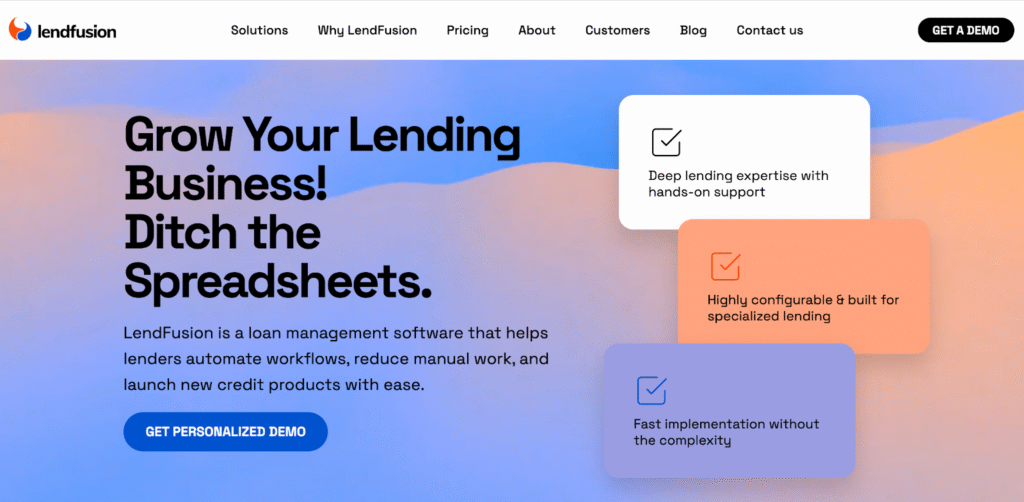
LendFusion is a full lending management system designed specifically for specialist lenders. From bridge finance to consumer credit, it centralizes origination, servicing, and repayments into a single, automation-first platform.
Where LendFusion shines is in its configurability. Instead of forcing lenders into rigid templates, it adapts to your workflows, ensuring repayments, schedules, and investor reporting are tracked exactly as your business requires.
Key Features
- Real-time repayment and delinquency tracking
- Automated loan events, reminders, and workflows
- Built-in audit trail with compliance-ready reporting
- Investor dashboards with transparent portfolio visibility
- Full EU hosting and GDPR compliance
LendFusion just might be the best loan management software on the market and is ideal for lenders managing between £10M and £50M portfolios. It’s especially suited for private credit providers, and digital-first lending businesses moving away from spreadsheets or fragmented CRMs.
Pros
- Fast, Configurable Setup — Go live in under 3 months with workflows designed around your lending model.
- Transparency by Default — Investor and regulatory reporting built into the platform, no extra tools required.
- Automation-First — Repayments, notices, and data exports happen without manual intervention.
Cons
- Not for Very Large Institutions — Global banks may seek larger vendors with 20+ year track records.
- Requires Initial Focus — Teams must commit time during onboarding to fully map and automate their processes.
Pricing
LendFusion starts at €1,659/month, scaling with portfolio size. All features, integrations, and support are included in a flat-fee model, with no per-user costs.
2. LoanPro
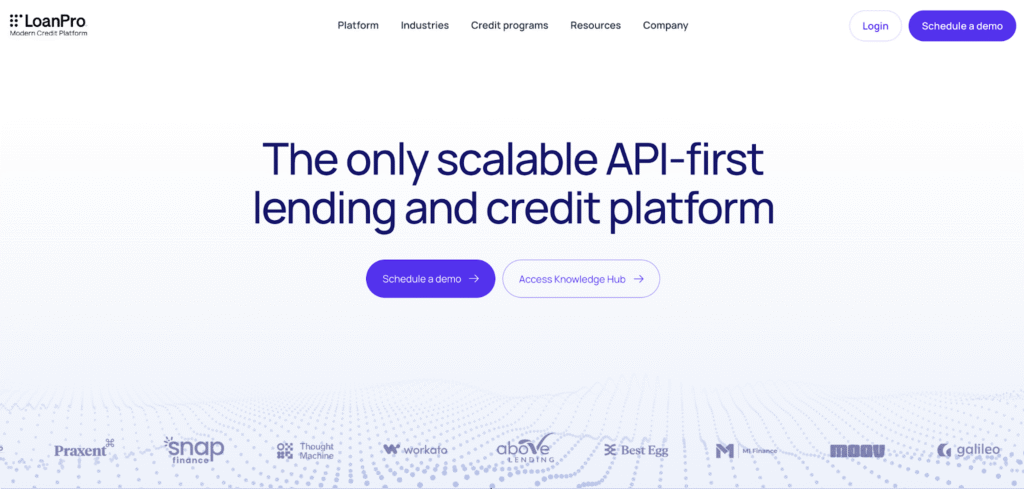
LoanPro is a developer-first loan tracking system built with APIs at its core. It’s particularly powerful for lenders with in-house engineering teams who want to customize repayment schedules, borrower data structures, and servicing logic without being constrained by a rigid platform.
This flexibility makes LoanPro one of the most popular loan tracking tools for fintechs, neobanks, and high-volume consumer lenders that need to design unique workflows and products at scale.
Key Features
- API-first architecture with webhooks for real-time data
- Advanced repayment logic for complex schedules
- Custom borrower and loan data structures
- Servicing suite covering collections, payments, and communication
- Reporting and analytics dashboards for portfolio health
LoanPro is best suited for lenders with in-house development resources, especially fintechs and scaling lenders that need a flexible, programmable core to support custom repayment structures and integrations.
Pros
- Ultimate Flexibility — APIs and custom fields give total control over loan structures and workflows.
- Scalability — Handles high loan volumes and complex portfolios without performance issues.
- Strong Integrations — Works well with custom-built apps and third-party financial tools.
Cons
- Complex Setup — Requires technical knowledge; not suited for teams without developers.
- Higher Costs — Pricing is tailored and often higher than SaaS-first platforms.
- Limited Out-of-the-Box UI — Less friendly for non-technical teams compared to SaaS solutions.
Pricing
LoanPro uses a custom pricing model based on portfolio size and product scope. Costs are typically higher than average due to its developer-focused architecture.
3. HES FinTech
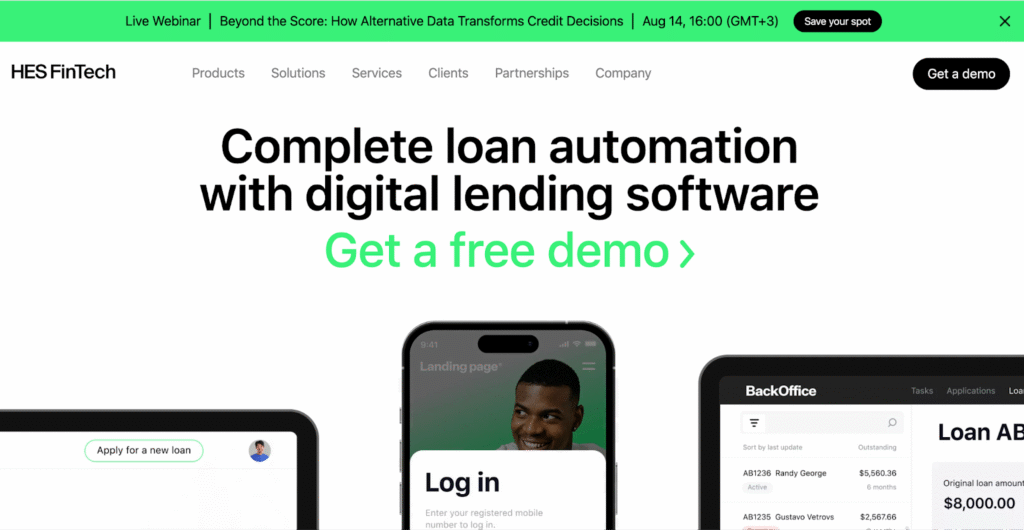
HES FinTech is a modular loan software for lenders that’s made a name for itself with AI-driven credit scoring and workflow automation.
Its loan tracking tools cover origination, servicing, collections, and reporting, but what really stands out is the ability to automate decision-making and adapt workflows to fit different lending models.
For lenders wanting more advanced analytics and intelligent loan tracking, HES brings enterprise-grade automation without having to build everything from scratch.
Key Features
- AI-powered credit scoring and borrower risk assessment
- Customizable workflow automation across the loan lifecycle
- End-to-end modules for origination, servicing, and collections
- Borrower and investor portals with role-based permissions
- Built-in compliance and reporting support
HES FinTech is best for mid-market to larger lenders that want to use automation to improve credit decisions, reduce servicing costs, and streamline back-office workflows. It’s especially relevant for consumer lenders, microfinance institutions, and SME-focused lenders.
Pros
- AI-Driven Decisions — Smarter, faster underwriting with real-time credit scoring.
- Flexible Automation — Highly customizable workflows to fit unique lending processes.
- Full Lifecycle Coverage — Modules for origination through collections, keeping everything under one system.
Cons
- Setup Complexity — AI features and modular builds take time to implement effectively.
- Enterprise Tilt — May be more than smaller lenders need, especially those just tracking loans.
- Customization Costs — Some advanced configurations require development support.
Pricing
HES FinTech offers pricing via consultation, with its LoanBox solution typically ranging between €20,000 and €70,000+, depending on modules and scope.
4. TurnKey Lender — Best for Rapid Deployment
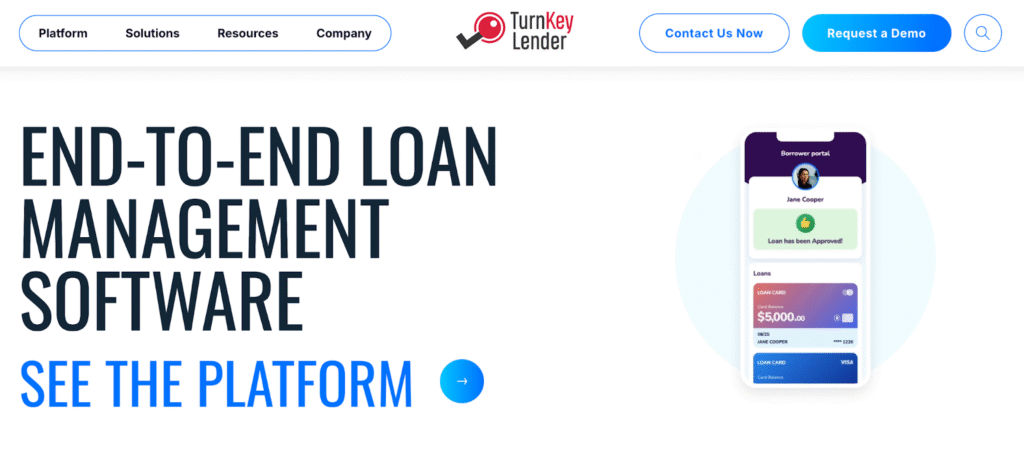
TurnKey Lender is an all-in-one lending automation platform known for its fast time-to-market. Its loan tracking capabilities are built into a broader suite that covers origination, underwriting, servicing, and collections.
What makes it stand out is the ability to get a live system up and running quickly — making it a favorite for digital-first lenders or embedded finance providers that need speed without building from scratch.
Key Features
- End-to-end loan lifecycle automation
- Proprietary AI-driven credit scoring engine
- Borrower and merchant portals for self-service access
- Compliance and reporting modules included
- Cloud deployment with global availability
TurnKey Lender is aimed at non-bank lenders, fintechs, and embedded finance providers that want to launch or expand lending operations fast. It’s best suited to teams with straightforward loan products that benefit from an out-of-the-box solution.
Pros
- Fast Go-Live — Prebuilt modules and templates allow quick deployment compared to custom platforms.
- Comprehensive Coverage — Includes origination, servicing, collections, and analytics under one roof.
- User-Friendly Interface — Clean UI for borrowers and lenders, reducing the training curve.
Cons
- Limited Flexibility — Less customizable than modular or API-first systems, making it harder to handle complex lending models.
- Opaque Pricing — Costs vary widely depending on setup and often lack transparency.
- Scaling Challenges — May struggle with very large or highly specialized portfolios.
Pricing
TurnKey Lender uses a quote-based model, with costs tied to portfolio size, number of users, and deployment type. While affordable for pilots, larger-scale usage can become expensive.
5. Neofin
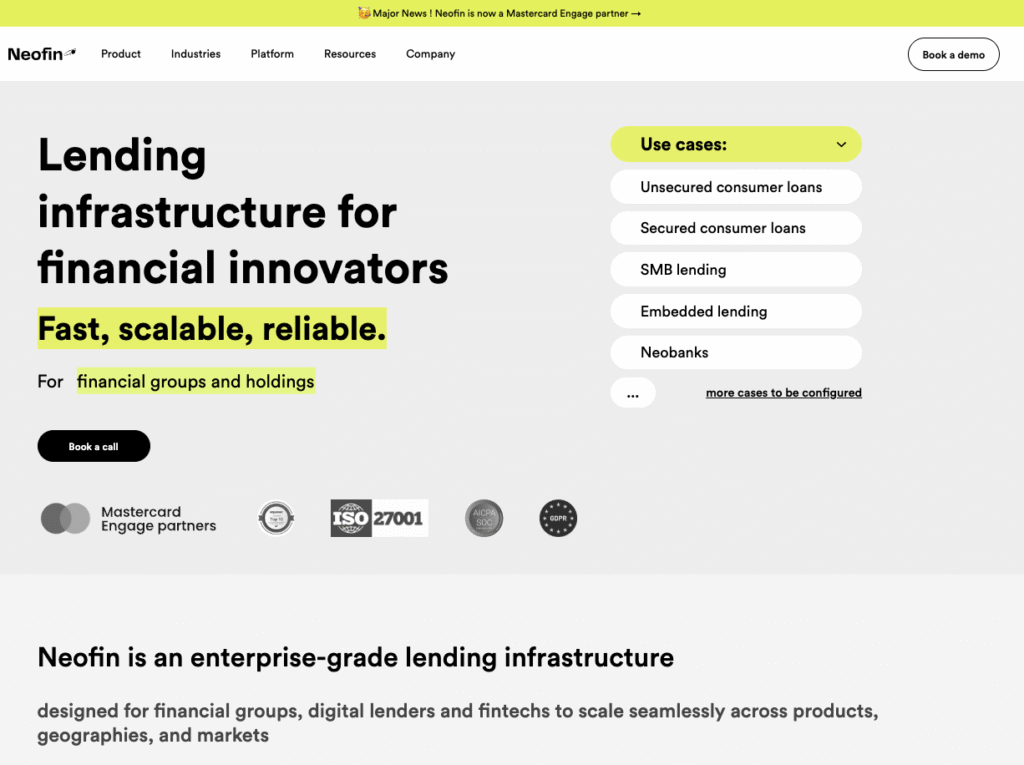
Neofin is a low-code loan management and tracking platform designed for lenders that want flexibility without heavy coding or custom development.
Its strength lies in enabling teams to build, adjust, and automate workflows visually — meaning lenders can adapt quickly as products, regulations, or customer demands change.
Key Features
- Low-code drag-and-drop workflow builder
- Automated decision-making and loan tracking tools
- Prebuilt integrations for payments, KYC/AML, and credit bureaus
- Real-time portfolio analytics and dashboards
- Secure, cloud-native infrastructure
Neofin is best suited for digital-first lenders, fintech startups, and mid-sized lending firms that need to move quickly but lack large IT teams. It’s especially valuable for lenders testing new loan products or expanding into new markets.
Pros
- Agile Workflow Customization — Build and change loan processes quickly without heavy dev resources.
- Strong Integration Ecosystem — Prebuilt connectors reduce implementation time.
- Real-Time Tracking — Clear dashboards and analytics make it easy to monitor loan performance.
Cons
- Not Ideal for Very Large Enterprises — May lack the depth of control larger banks or global institutions demand.
- Learning Curve for Non-Technical Users — While low-code, it still requires process knowledge to get the most value.
- Pricing Can Scale Quickly — Depending on the number of modules and workflows deployed.
Pricing
Neofin offers subscription-based pricing, with costs varying by loan volume and number of modules. It’s generally competitive for mid-sized lenders but can increase with advanced customization.
6. LendFoundry
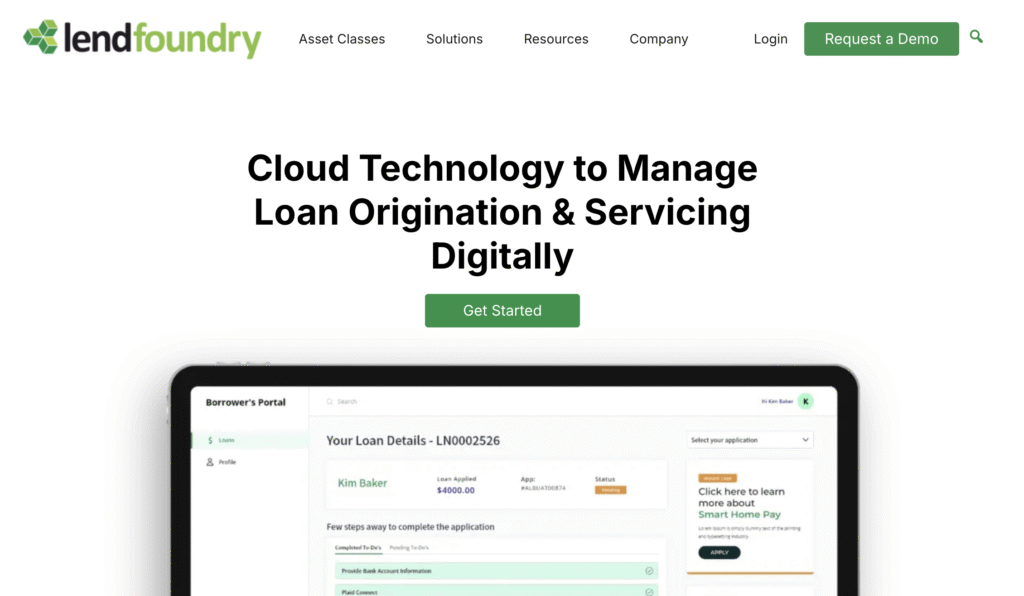
LendFoundry positions itself as a next-gen, API-first loan management and tracking system, designed to integrate seamlessly into broader financial ecosystems.
Unlike platforms that operate as closed systems, LendFoundry provides modular, API-driven tools for origination, servicing, risk management, and analytics — making it a flexible backbone for lenders with complex tech stacks.
Key Features
- 100+ prebuilt APIs for payments, KYC, credit, and collections
- End-to-end loan origination and servicing workflows
- Real-time loan tracking with configurable dashboards
- Built-in risk and fraud detection tools
- Scalable, cloud-native infrastructure
LendFoundry is best for tech-savvy lenders, fintechs, and digital banks that prioritize integration and customization over out-of-the-box simplicity. It works particularly well for firms building lending products that must slot into broader ecosystems — like embedded finance or banking-as-a-service.
Pros
- API-First Flexibility — Deep integrations with third-party tools make it ideal for complex environments.
- Modular Approach — Use only the components you need, scaling as your lending model evolves.
- Strong Data Access — Real-time visibility and reporting across all loan stages.
Cons
- Requires Tech Resources — Not suited for lenders without an IT team or integration capability.
- Longer Implementation — Compared to turnkey SaaS platforms, setup is more involved.
- Best for Digital Lenders — May not fit traditional lenders seeking simplicity.
Pricing
LendFoundry uses customized pricing based on modules, loan volumes, and integration requirements. It’s cost-effective for lenders with strong dev capacity but may feel complex for smaller operators.
7. BrightOffice

BrightOffice is a UK-based loan management and tracking system built with SME lenders in mind. It focuses on simplicity, compliance, and affordability — making it an attractive option for smaller lenders who don’t need the complexity (or cost) of enterprise-grade platforms.
Key Features
- Built-in compliance tools for UK financial regulations
- Document Management System (DMS) for secure loan records
- End-to-end workflows for origination, servicing, and collections
- Customizable loan product templates
- Cloud-based access with simple, intuitive UI
BrightOffice is designed for small-to-mid-size lenders in the UK, including property finance providers, consumer lenders, and regional finance companies. It’s especially well-suited for teams who want affordable software with built-in compliance tracking.
Pros
- Affordable and Accessible — A lower-cost option with the core functionality smaller lenders need.
- Compliance Support — Features tailored to UK lending regulations, including audit-ready reporting.
- Simple to Use — User-friendly interface reduces training time and complexity.
Cons
- Limited Scalability — May struggle to support very high loan volumes or more complex structures.
- Fewer Advanced Features — Lacks some of the automation and customization options offered by larger platforms.
- UK-Focused — Best for domestic lenders; limited support for cross-border or multi-market operations.
Pricing
BrightOffice pricing starts from around €995/month, with costs scaling based on loan volumes and added features. It’s one of the more budget-friendly options on the market.
Comparing the 7 Best Loan Tracking Software Platforms
With so many options available, it helps to see the differences at a glance. Here’s how the leading loan tracking systems stack up on key criteria like pricing, scalability, and best-fit users.
| Platform | Best For | Pros | Cons | Pricing |
|---|---|---|---|---|
| LendFusion | Fast, configurable lending models | EU-hosted, automation-first, scalable, transparent pricing | Requires focus during setup, niche specialist scope | €1,659–€9,999/month |
| LoanPro | Tech teams wanting API-first control | Developer flexibility, robust integrations, scalable | Complex, costly for smaller lenders | Custom quote |
| HES FinTech | AI-powered automation & credit scoring | Advanced AI features, customizable workflows | High setup cost, slower time-to-market | €20K–€70K+ |
| TurnKey Lender | Rapid deployment with pre-built templates | All-in-one, embedded AI, user-friendly UI | Limited flexibility, opaque pricing | Custom quote |
| Neofin | Fast SaaS origination and tracking | Quick deployment, compliance-ready, modular tools | Still growing, limited enterprise features | From ~$1,000/month |
| LendFoundry | Embedded finance & digital-first lenders | Strong modular suite, API-driven, partner ecosystem | Mostly US-focused, integration required | Custom quote |
| BrightOffice | SME lenders in the UK | Affordable, simple, compliance tools built-in | Limited scalability, fewer advanced features | From €995/month |
Choosing the right loan tracking software isn’t just about features—it’s about finding a platform that aligns with your lending model today and scales with you tomorrow.
Final Thoughts
Loan tracking software isn’t just about monitoring balances — it’s about streamlining operations, protecting compliance, and giving your team back the time to grow the business.
From LendFusion’s configurable, automation-first approach to BrightOffice’s SME-friendly simplicity, there’s a solution for every type of lender. The key is to pick the platform that fits your current portfolio size, technical resources, and long-term growth strategy.
Ready to see why LendFusion is the best choice for scaling specialist lenders?
Book a personalized demo today and discover how you can replace fragmented tools and legacy systems with a single, modern platform built for speed and compliance.
🚀 Ready to Take Your Lending Business to the Next Level?
Download our Loan Management Software Buyer’s Comparison Checklist and discover all the nuances to consider when shopping for a loan management platform. Identify, evaluate, estimate, compare.
No fluff — just practical examples, templates, and expert tips.
No sign-up required. Just download and start improving your lending business today.

Vahuri Voolaid, COO
Vahuri is the Chief Operations Officer at LendFusion. Vahuri has 8 years of experience in fintech with loan management software as a product owner and an MBA with a specialisation in IT management.
Connect with Vahuri on LinkedIn.